Updated November 9, 2026 · An evidence-based 2027 outlook · Research cutoff: November 9, 2026
AI in 2027: the short answer
AI in 2027 is likely to be about agents that finish real work, not chatbots that only answer questions. Going into 2027, the best-positioned AI tools are ChatGPT, Google Gemini and Claude for general use, Microsoft Copilot for work, GitHub Copilot, Claude Code, Codex and Cursor for coding, and Google for AI search.
AI in 2027 will probably be defined less by chatbots giving better answers and more by software that finishes the work: researching, coding, building documents, working across apps, handling customer calls and starting to act in the physical world. Every major AI company launched an agent product in 2026.
| Category | Brands best positioned going into 2027 | Why (verified 2026 evidence) |
|---|---|---|
| General AI assistant | ChatGPT, Google Gemini, Claude | Top 3 in chatbot web traffic; ChatGPT 1.2B weekly users, Gemini app 1B+ monthly users |
| AI at work | Microsoft 365 Copilot, Gemini Enterprise, Salesforce Agentforce, ChatGPT Work | 30M+ paid Copilot seats; enterprise agent platforms launched in 2026 |
| Coding | GitHub Copilot, Claude Code, OpenAI Codex, Cursor | 50M Copilot users; 5M+ weekly Codex users; Claude Code a $1B product |
| Search & research | Google AI Mode / AI Overviews, ChatGPT, Perplexity, NotebookLM | AI Overviews 2.5B+ and AI Mode 1B+ monthly users |
| Video & design | Google Gemini Omni / Veo / Flow, Runway, Adobe Firefly, Canva | Shipping generation-plus-editing workflows (Sora was shut down) |
| Voice | ElevenLabs, Gemini Live, Alexa+, Siri AI | Voice agents in production; 63% of Gemini users talk to it |
| Open models | Gemma 4, DeepSeek V4, Mistral Large 4 | Open-weight releases in 2026 |
| Glasses & robots | Meta AI glasses, Android XR (XREAL AURA), NVIDIA Isaac, Gemini Robotics 2 | New products and platforms in 2026 |
These are contenders, not certified 2027 winners. This article separates three things: verified facts as of November 2026, companies' own stated plans, and our editorial expectations. Nobody has measured a year that hasn't happened yet.
Where AI stands going into 2027
AI enters 2027 with near-universal business adoption, agents that complete about two-thirds of benchmark computer tasks, and billion-user consumer products, but also with rising incidents and no common way to measure usage.
The Stanford AI Index 2026 offers the clearest baseline:
- 88% of organizations report regular AI use in at least one business function, up from 78% a year earlier. The figure comes from McKinsey's self-reported survey, which the Index cites, so treat it as directional.
- AI agents went from roughly 12% to 66.3% on OSWorld, a benchmark of real computer tasks, in one year. That still means failing about one in three benchmark tasks.
- Documented AI incidents rose from 233 in 2024 to 362 in 2025.
- As of March 2026, the top US model led the best Chinese model by just 2.7% on Stanford's benchmark set.
Commercial scale is just as striking, but each company measures something different:
- OpenAI cited "our collective 1.2B weekly users" at DevDay 2026 on September 29, 2026.
- Google Gemini: "More than 1 billion people are using the Gemini app every month" (Google, August 11, 2026).
- Google Search: AI Overviews has over 2.5 billion monthly active users, and AI Mode passed 1 billion (Google I/O 2026 keynote).
- Microsoft: Microsoft 365 Copilot "reached over 30 million paid seats" and "GitHub Copilot now has 50 million users" (Microsoft 2026 Annual Report).
Important: weekly users, monthly users, paid seats and website visits are not interchangeable. These figures show scale. They don't make an apples-to-apples league table.
Which AI assistants lead today? The measured baseline
ChatGPT leads AI chatbot website traffic with 56.4% of visits in September 2026, followed by Gemini (25.0%) and Claude (9.6%), according to Similarweb. Gemini grew fastest over the past year.
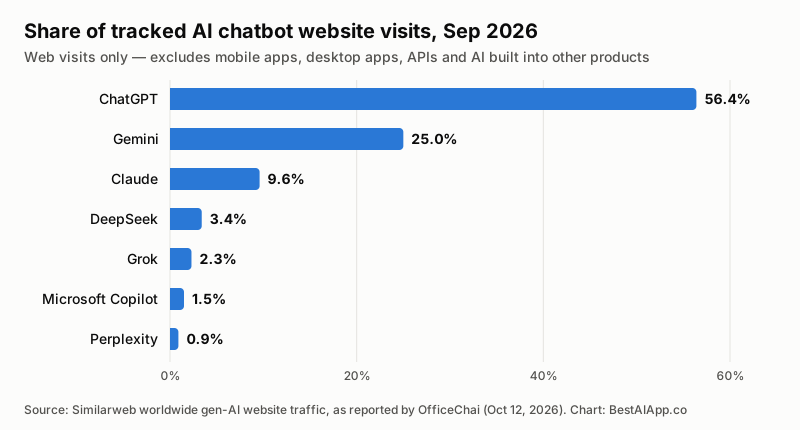
| Assistant | Share of tracked AI chatbot website visits, Sep 2026 |
|---|---|
| ChatGPT (OpenAI) | 56.4% |
| Gemini (Google) | 25.0% |
| Claude (Anthropic) | 9.6% |
| DeepSeek | 3.4% |
| Grok (xAI) | 2.3% |
| Microsoft Copilot | 1.5% |
| Perplexity | 0.9% |
Source: Similarweb worldwide generative-AI website traffic, as reported by OfficeChai (October 12, 2026). Website visits only: this excludes mobile apps, desktop apps, API usage and AI built into other software.
The trend matters more than the snapshot. On the same Similarweb measure, ChatGPT's share fell from 71.8% (October 2025) to 53.7% (April 2026) and has since recovered to 56.4% (September 2026). Gemini nearly doubled from 13.6% to 25.0% over the same 12 months, after reaching 26.7% in April 2026. Claude rose from 8.0% (April 2026) to 9.6%. Similarweb's own 2026 analysis found ChatGPT's visit count stayed roughly flat while the overall category grew. In other words, ChatGPT didn't lose visitors. Rivals grew faster.
How to read this: ChatGPT leads this specific web-traffic measure. That doesn't mean it has 56.4% of all AI users, that Copilot is small inside Microsoft 365, or that Meta's AI reach is captured here.
AI trends 2027: ten developments to watch
The ten AI trends most likely to shape 2027, based on what companies shipped in 2026:
- Agents move from answering questions to completing tasks
- Personal assistants become proactive and context-aware
- Enterprise AI becomes a contest over who owns the workflow
- AI coding shifts from autocomplete to finished software
- AI search and research keep reshaping discovery
- Image and video generation become complete creative workflows
- Voice becomes a real interface for service and everyday tasks
- Open-weight and on-device AI pressure closed-only strategies
- AI gets more visible in glasses, robots and devices
- Security, proof of value and cost control become advantages
1. AI agents will move from answering questions to completing tasks
In short: OpenAI, Google, Meta and Microsoft all launched agents in 2026 that work on multi-step tasks for hours and ask before sensitive actions. Expect more people to hand off bounded jobs in 2027.
Verified now:
- OpenAI launched ChatGPT Work on July 9, 2026. It's an agent that can "stay with complex projects for hours," pulling from connected apps to produce finished sheets, slides, docs and web apps. It rolled out first to Pro, Enterprise and Edu users.
- At DevDay 2026, OpenAI introduced Dots, which LetsDataScience reported as an always-on assistant that keeps working in the background.
- Google announced Gemini Spark, a 24/7 cloud agent that works across Gmail, Docs and other connected apps and asks before high-stakes actions. Google said it would roll out as a beta to US Google AI Ultra subscribers.
- Meta launched Muse on September 8, 2026. It runs on a dedicated cloud virtual machine, acts in the apps people already use, and checks with the user before sensitive actions like sending email or buying something.
- Microsoft made Copilot Cowork generally available worldwide on June 16, 2026, after an early-access preview in its Frontier program. Microsoft says "you define the work and Cowork runs it end-to-end and returns a completed result." It requires a Microsoft 365 Copilot license, admins control access, and usage is billed separately.
Our 2027 expectation (high confidence in the direction, not in universal reliability): More people will delegate bounded workflows: research briefs, reconciling spreadsheets, following up on approved tasks, comparing purchases. The winning agents will be the ones that finish the job correctly, ask permission at the right moments and leave a record you can review. Sounding fluent won't be enough.
Brands to watch: ChatGPT Work and Dots, Gemini Spark, Meta Muse, Microsoft Copilot Cowork, Claude.
2. Personal assistants will become proactive and context-aware
In short: Google, Apple, Meta and Amazon are building assistants that use your email, calendar and files to act before you ask. The deciding factors in 2027 will be permissions, privacy and regional availability.
Verified now:
- Google's opt-in Daily Brief compiles urgent email, calendar events and follow-ups each morning.
- Apple began rolling out Siri AI in beta, in English, on September 14, 2026 (Apple). Apple says its models were "custom-built in collaboration with Google and its Gemini models." Apple's June 2026 announcement describes personal context (finding a hotel confirmation in an old email, for example) and actions across apps. It launched in English and isn't initially available on iPhone in the EU or in China.
- Meta's Muse "remembers what matters to a person," and users can tell it to forget specific things. It launched in the US and was available in Singapore by late October 2026.
- Amazon's Alexa+ is live in the US, Brazil, Canada, Mexico, the UK, Germany, Italy, Spain, France, Australia, India and Japan (Amazon).
Our 2027 expectation (medium confidence): The battleground may shift from the smartest model to the assistant with the right permissions and context across your email, calendar, files and devices. Privacy controls, regional availability, and the ability to disconnect integrations will matter as much as raw intelligence.
Brands to watch: Google Gemini, ChatGPT, Apple Siri AI, Meta Muse, Amazon Alexa+.
3. Enterprise AI becomes a contest over who owns the workflow
In short: Microsoft, Google, Salesforce and AWS all launched platforms in 2026 to build and govern business agents. In 2027 the fight is over control of agent identity, permissions, audit logs and cost.
Verified now:
- Google launched the Gemini Enterprise Agent Platform (April 2026) to build, scale and govern agents. It offers both Gemini and Anthropic Claude models.
- Microsoft's Copilot Studio added Agent 365, described as "the centralized control plane for managing agents."
- Salesforce says it has delivered 7 billion "Agentic Work Units" across Agentforce and Slack (Salesforce, September 2026). That's Salesforce's own metric, not an industry standard.
- AWS rebuilt the Amazon Bedrock AgentCore Runtime (September 2026) for deploying and running agents.
Our 2027 expectation (high confidence): Companies will spend less time debating which chatbot writes the best paragraph and more time deciding who controls agent identity, permissions, audit logs, costs and integration with existing systems. An AI tool built into the CRM or office suite can be very valuable even if its public website gets little traffic. That's why Microsoft Copilot's 1.5% web share understates its position.
Brands to watch: Microsoft 365 Copilot and Copilot Studio, Google Gemini Enterprise, Salesforce Agentforce, Amazon Bedrock AgentCore, ChatGPT Work, Anthropic Claude for enterprise.
4. AI coding shifts from autocomplete to delivering finished software
In short: GitHub Copilot (50M users), OpenAI Codex (5M+ weekly users), Claude Code and Cursor are all moving to agents that plan and deliver whole changes. No single winner is established.
Verified now:
- GitHub Copilot has 50 million users (Microsoft). At GitHub Universe 2026 (October 28) GitHub launched an agent-first Copilot app, Copilot projects for running agent work across many repositories, and Copilot Fusion for routing tasks across models. Its stated goal: "Completed work, not more code, is the output that matters."
- OpenAI Codex passed 5 million weekly users in June 2026 (OpenAI: "more than 5 million people now use Codex every week").
- Claude Code "grew from a research preview to a billion-dollar product in six months," according to Anthropic.
- Cursor launched Projects in beta on September 10, 2026. A coordinator agent plans long-running work and hands it to subagents in the cloud.
Our 2027 expectation (high confidence on the trend, no credible single winner): Coding tools will compete on fixed bugs, tests, pull-request quality, security checks and human review. Teams should measure accepted, production-safe changes per dollar, not lines of generated code.
Brands to watch: GitHub Copilot, Claude Code, OpenAI Codex, Cursor. Copilot's total users can't be compared directly with Codex's weekly users.
A separate market: AI app builders for non-developers. Replit Agent 4 (March 2026) added team collaboration, an infinite Design Canvas and parallel agents. In October 2026, Lovable let apps built on its platform use outside models and tools, including OpenAI voice, Claude, Gemini, Perplexity and Firecrawl. Our expectation (medium confidence): these tools will make it easier for small businesses and solo founders to build internal tools and simple customer apps. That isn't evidence of which builder leads, and it isn't proof that generated apps are secure or production-ready.
5. AI search and research keep reshaping how people find things
In short: Google AI Overviews has 2.5B+ monthly users and AI Mode 1B+, with queries three times longer than classic search. People will increasingly ask an assistant instead of clicking links.
Verified now:
- Google says AI Mode passed 1 billion monthly users globally and that "the average AI Mode search is triple the length of a traditional Search query."
- Google upgraded NotebookLM in June 2026. It can now run code in a secure cloud computer and produce charts, documents, spreadsheets and slide decks. These features launched first for Google AI Ultra and business customers.
Our 2027 expectation (high confidence that discovery keeps changing; the impact on any one publisher is uncertain): People will increasingly ask an assistant to compare, summarize and recommend rather than click through ten links. Publishers will need accurate, original, verifiable content. Search clicks, AI referrals and brand mentions should be tracked separately.
Brands to watch: Google AI Mode and AI Overviews, ChatGPT, Perplexity, Gemini, NotebookLM.
6. Image and video generation become complete creative workflows
In short: Google, Runway, Adobe and Canva are combining generation with editing and brand tools. OpenAI shut down Sora in 2026, so it isn't a 2027 contender.
Verified now:
- Google introduced Gemini Omni at I/O 2026 (May 19). Google describes it as a model that "can create anything from any input, starting with video," with conversational editing. It's available in Flow to Google AI subscribers globally. Google's Veo 3.1 also remains available.
- Runway offers Gen-4.5 for text-to-video and image-to-video. In May 2026 it launched Aleph 2.0 and Edit Studio for targeted edits to existing footage.
- Adobe Firefly and Creative Cloud offer partner models from Google, OpenAI, Runway, Luma, Black Forest Labs, Kling and others alongside Adobe's own.
- Canva AI 2.0 (April 2026, launched as a research preview, per SiliconANGLE's report of Canva's announcement) creates editable designs from plain-language requests and can run multi-step campaigns from a single brief.
Our 2027 expectation (medium-to-high confidence): The most useful creative products will combine generation with editing, brand consistency, collaboration, licensing choices and publishing. A repeatable campaign workflow will be worth more than one impressive clip.
Brands to watch: Google Gemini Omni / Veo / Flow, Runway, Adobe Firefly, Canva. Don't list OpenAI Sora as a 2027 contender. OpenAI discontinued the Sora web and app products on April 26, 2026, and the API on September 24, 2026.
7. Voice becomes a real interface for customer service and everyday tasks
In short: Voice agents from ElevenLabs and others already handle live customer calls, and 63% of Gemini users talk to it. In 2027, detecting AI callers and escalating to humans will matter.
Verified now:
- ElevenLabs voice agents hold real-time conversations, pull from company knowledge bases, call business systems mid-call and hand off to a human when needed.
- In October 2026 ElevenLabs added synthetic-voice detection, noting that "a growing share of the calls reaching businesses and governments aren't people." It also joined the Meta- and Sierra-led Personal Agent Protocol effort, which aims to define how a personal AI agent identifies itself to a business.
- Google says 63% of Gemini users now talk directly to it by voice.
Our 2027 expectation (medium confidence): Voice will become a more common way to handle errands, support calls and scheduling, including AI agents calling businesses on someone's behalf. Reliability, consent, fraud detection and escalation to a human will be essential. A human-sounding voice is no proof the agent can do the task safely.
Brands to watch: ElevenLabs, Gemini Live, Alexa+, Siri AI.
8. Open-weight and on-device AI put pressure on closed-only strategies
In short: Gemma 4, DeepSeek V4 and Mistral Large 4 released open weights in 2026, giving developers cheaper, private options. Check each license: open-weight isn't always open-source.
Verified now:
- Google's Gemma 4 (April 2026, Apache 2.0 license) includes small models designed for phones and other compact devices that can run fully offline (Google).
- DeepSeek V4 Preview (April 24, 2026) released open weights with a 1M-token context.
- Mistral Large 4 (Italian-language page) released its weights under a modified MIT license that requires a separate commercial license for companies offering it as a hosted service.
Our 2027 expectation (high confidence that choice grows; rankings uncertain): Developers will have more reasons to weigh hosted frontier models against cheaper, private or local alternatives. The right choice will depend on performance, data handling, license terms and total cost, not only leaderboard scores.
Brands to watch: Google Gemma, DeepSeek, Mistral. Open-weight doesn't automatically mean open-source, as Mistral's license shows.
9. AI gets more visible in glasses, robots and devices
In short: AI glasses from Meta and XREAL went on sale in 2026, and Google DeepMind and NVIDIA released new robotics platforms. Expect visible progress in 2027, not mass-market household robots.
Verified now:
- Glasses: Google and XREAL opened orders for XREAL AURA on October 28, 2026. These wired Android XR glasses start at $1,099, and Gemini can see what you're looking at. At Connect 2026, Meta said it is bringing Muse to its AI glasses "in the coming months."
- Robotics: Google DeepMind released Gemini Robotics 2 (July 30, 2026), with whole-body control for humanoids. Its reasoning model is in Google AI Studio, and its motion models are limited to trusted testers. NVIDIA expanded its Isaac platform (October 21, 2026), and partner Agile Robots announced a research humanoid scheduled for early 2027.
Our 2027 expectation (medium confidence in visible progress; low confidence in mass-market household humanoids): Expect more demos, developer platforms and specialized deployments. A research robot completing a controlled task doesn't prove that affordable household humanoids are ready.
Brands to watch: Meta AI glasses, Android XR (XREAL AURA), NVIDIA Isaac and Jetson, Google DeepMind Gemini Robotics.
10. Security, proof of value and cost control become competitive advantages
In short: Gartner forecasts over 40% of agentic AI projects will be canceled by end-2027. Businesses that measure outcomes and control risk will get the most value.
Verified now: Gartner forecasts that over 40% of agentic AI projects will be canceled by the end of 2027, citing rising costs, unclear business value and inadequate risk controls. That's an analyst forecast from June 2025, not a measured cancellation rate. Meanwhile, Stanford recorded a rise in documented AI incidents from 233 to 362.
Our 2027 expectation (high confidence): The businesses that get real value from AI will prioritize measurable outcomes, clear permissions, logging, human approvals and fallback paths. Model prices alone don't reveal the true cost of failed tasks, retries, review time and security incidents.
Brands to watch: This isn't a single-brand contest. Agent governance features like Microsoft Agent 365, plus independent evaluators and identity providers, stand to benefit.
Best AI tools for 2027: which could dominate?
No single AI tool will dominate 2027. The strongest positions belong to ChatGPT (consumer reach), Google Gemini (distribution through Search and Android), Microsoft Copilot (workplace and developer tools) and Claude (coding and professional work), with different leaders in each category.
This table is editorial analysis based on documented 2026 products and distribution. It's not a market-share forecast.
| Category | Leading contenders | Evidence-based reason to follow them | Main uncertainty |
|---|---|---|---|
| General-purpose assistant | ChatGPT, Gemini, Claude | Top 3 by chatbot web traffic; largest reported user bases | Retention, pricing, model changes |
| AI inside work software | Microsoft 365 Copilot, Gemini Enterprise, Salesforce Agentforce, ChatGPT Work | Existing enterprise distribution and agent tooling | Proven ROI, deployment complexity |
| Personal task agents | ChatGPT Work / Dots, Gemini Spark, Meta Muse, Copilot Cowork | Launched multi-step, background-working agents in 2026 | Access, privacy, task failure rates |
| Coding agents | GitHub Copilot, Claude Code, Codex, Cursor | Large, documented usage and fast feature shipping | Code quality, cost, lock-in |
| AI app builders | Lovable, Replit | Shipping conversational app-building and collaboration | Security, maintainability |
| AI search & research | Google AI Mode, ChatGPT, Perplexity, NotebookLM | Deployed at billion-user scale (Google) | Citation accuracy, publisher traffic |
| Image & video | Google Gemini Omni / Veo / Flow, Runway, Adobe Firefly, Canva | Generation plus editing in one workflow | Cost, consistency, rights |
| Voice | ElevenLabs, Gemini Live, Alexa+, Siri AI | Active voice-agent products | Reliability, impersonation, regional rollout |
| Open-weight AI | Gemma, DeepSeek, Mistral | 2026 open-weight releases | Licenses, operating cost |
| Physical AI | NVIDIA Isaac, Gemini Robotics, Meta glasses, Android XR | Shipping hardware and developer platforms | Safety, price, scale |
Our strongest 2027 positioning calls:
- OpenAI / ChatGPT starts with the clearest consumer lead: 56.4% of chatbot web traffic and 1.2B weekly users. Its share has fallen sharply in a year, though.
- Google has the biggest distribution advantage through Search (AI Overviews 2.5B+ monthly users), Android, the Gemini app (1B+) and Workspace. It was the fastest-growing assistant over the past 12 months.
- Microsoft is strongest in paid workplace AI (30M+ Copilot seats) and developer tools (50M GitHub Copilot users).
- Anthropic / Claude is a serious contender in coding and professional work. Claude Code became a billion-dollar product, and Claude's web share grew to 9.6%.
These assess positioning today. They aren't probabilities.
Challengers to watch:
- Meta Muse could matter because Meta can put an agent inside apps people already use, but no independent usage data exists yet.
- DeepSeek and Mistral keep pressure on price and deployment options.
- Canva and Adobe benefit from owning end-to-end creative workflows.
What is actually scheduled or targeted for 2027?
Only a few AI events in 2027 are confirmed: NVIDIA GTC in March, Amazon's plan to bring Alexa+ to 10+ more countries, and Anthropic's target to train 10,000 engineers. No AI lab has published a 2027 model release calendar.
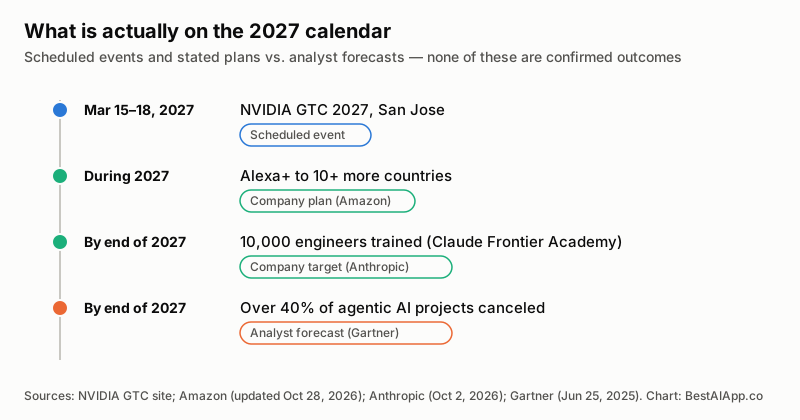
Don't confuse these with our predictions:
- NVIDIA GTC 2027: NVIDIA's GTC page lists the conference for March 15–18, 2027 in San Jose. Its key themes include agentic AI, AI infrastructure, and physical AI and robotics. (NVIDIA's FAQ gives March 14–18, so check before publishing.) The agenda doesn't guarantee any specific launch.
- Amazon Alexa+: "We'll also expand Alexa+ to more than 10 additional countries in 2027" (Amazon). Amazon hasn't named the countries. This is a company plan, not a completed rollout.
- Anthropic: Through its Claude Frontier Academy, Anthropic "aims to train 10,000 Frontier Deployed Engineers by the end of 2027," backed by a $100 million commitment. This is a target, not an outcome.
- Gartner: The over-40% agentic-AI-project cancellation figure is a forecast, not a calendar event.
There is no verified 2027 release calendar for the next flagship model from any major AI lab. Any article promising a specific model name on a specific date is speculating unless the company has announced it.
How to choose AI tools for 2027 without chasing hype
Before paying for another AI subscription, test it against a real workflow:
- Define the outcome. For example, "find three credible suppliers and produce a comparison I can audit," not "write a smart answer."
- Run the same task several times. Check factual accuracy and how often it finishes without you rescuing it.
- Check integrations and permissions. Can it reach the apps it needs without getting more access than necessary?
- Measure the full cost. Include subscription or API fees, failed attempts, review time and corrections.
- Make sure you control your work. Check export options, logs, privacy terms and how easy it is to switch tools.
For hands-on comparisons, see our guides to Gemini vs ChatGPT, Cursor vs GitHub Copilot vs Claude Code, Windsurf vs Cursor vs Claude Code and the best AI research tools.
FAQ
What are the biggest AI trends for 2027?
The biggest AI trends for 2027 are agents that complete multi-step tasks, proactive personal assistants, enterprise agent platforms, coding agents that ship finished software, AI search, creative tools that combine generation with editing, voice agents, open-weight models, AI glasses and robotics, and a stronger focus on proving value and controlling cost.
Will ChatGPT still be the biggest AI tool in 2027?
ChatGPT starts 2027 in the lead: 56.4% of tracked chatbot web visits in September 2026 and 1.2 billion weekly users cited by OpenAI. But its web share fell from 71.8% in October 2025, and no data can measure 2027 yet. "Biggest" also depends on the metric: web visits, weekly users, paid seats or AI built into other apps.
Will Google Gemini overtake ChatGPT in 2027?
It's possible but not established. The Gemini app passed 1 billion monthly users in August 2026, and Google reaches billions more through AI Overviews and AI Mode in Search. On Similarweb's web-traffic measure, Gemini held 25.0% in September 2026, down slightly from 26.7% in April. Any "overtaking" claim needs a named metric and 2027 data.
What is the biggest AI trend for businesses in 2027?
Reliable task execution: agents connected to business systems, with permissions, measurable results and human oversight. Gartner's forecast that over 40% of agentic AI projects will be canceled by end-2027 is a strong reason to focus on reliability rather than marketing claims.
Which AI coding tools are worth watching?
GitHub Copilot, Claude Code, OpenAI Codex and Cursor are all credible 2027 contenders based on 2026 usage and product launches. None can be called the 2027 leader without a defined benchmark and current-year evidence.
Is OpenAI's Sora still available?
No. OpenAI discontinued the Sora web and app products on April 26, 2026, and the Sora API on September 24, 2026. It's a reminder that even high-profile AI products aren't guaranteed to survive.
Will AI replace every app or every job in 2027?
No evidence supports such an absolute claim. Even the best agents in Stanford's data still fail about a third of benchmark computer tasks. Reliability, integration, regulation and cost limit how quickly whole workflows can be automated.
Final outlook: a battle for trusted execution, not one AI champion
The most defensible forecast for 2027 isn't that one AI brand will control everything. It's that the winners in each category will be the products that turn AI capability into reliable results. OpenAI, Google, Microsoft, Anthropic, Meta, Amazon, Apple, Salesforce, NVIDIA, Adobe, Canva, Runway, ElevenLabs and the open-model developers all start from different positions.
Track real usage, shipped features, task-completion reliability, distribution and cost. Treat everything else, including future model names and declarations of market leadership, as a hypothesis until the evidence arrives.
Sources and methodology
Research cutoff: November 9, 2026. This article uses industry research, company reports, product announcements and one clearly labeled third-party web-traffic series. User counts and performance claims reported by companies are attributed to them, not treated as independent audits. The 2027 sections are editorial expectations, not verified future facts. BestAIApp didn't run hands-on benchmark tests for this article.
Main sources: Stanford AI Index 2026 · Similarweb data via OfficeChai · Similarweb AI Search Stats 2026 · OpenAI DevDay 2026 · Google Gemini 1B users · Google I/O 2026 · Microsoft 2026 Annual Report · GitHub Universe 2026 · Anthropic Claude Frontier Academy · Meta Muse · Salesforce Agentforce · Amazon Alexa+ · Gartner forecast · OpenAI Sora discontinuation · NVIDIA GTC